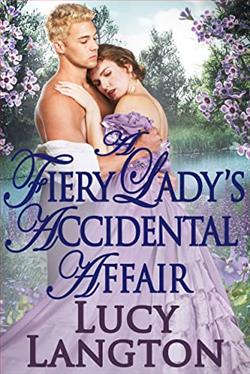
In Lucy Langton's captivating novel, A Fiery Lady's Accidental Affair, readers are transported into the heart of 19th-century England, where societal expectations clash with personal desires. The story revolves around Alicia Ramsbury, a young woman trapped in the gilded cage of London’s high society, and Laurence Gillingham, a rugged farmer who embodies the spirit of the countryside. This tale of love, self-discovery, and the struggle against societal norms is both engaging and thought-provoking.
The novel opens with Alicia feeling suffocated by her life in London, where her only relative, a patronizing sister, adds to her sense of entrapment. Langton does an excellent job of establishing Alicia's internal conflict early on. The reader can sense her yearning for freedom and authenticity, which sets the stage for her transformative journey. The moment her carriage is wrecked and she is rescued by Laurence, the narrative takes a turn that is both thrilling and romantic. This incident serves as a catalyst for Alicia’s awakening, pushing her out of her comfort zone and into the arms of a man who represents everything she has been missing.
Laurence Gillingham is a well-crafted character whose love for the countryside starkly contrasts with Alicia's high-society upbringing. He is depicted as a man of integrity and strength, deeply connected to the land and its rhythms. His character development is particularly compelling as he grapples with the intrusion of Alicia's world into his peaceful existence. The chemistry between Alicia and Laurence is palpable, and their interactions are charged with a mix of tension and tenderness. As they navigate their differences, the novel explores themes of class disparity and the societal pressures that dictate personal choices.
One of the most striking aspects of A Fiery Lady's Accidental Affair is its exploration of the theme of self-discovery. Both Alicia and Laurence are on journeys to find their true selves, albeit from different starting points. Alicia's journey is one of breaking free from societal constraints, while Laurence's is about embracing the emotional depth that Alicia brings into his life. Their relationship serves as a mirror, reflecting their insecurities and desires. Langton skillfully illustrates how love can be both a liberating force and a source of conflict, as the couple must confront their own prejudices and the expectations of their respective worlds.
The pacing of the novel is well-balanced, allowing for moments of introspection alongside the more dramatic developments in the plot. Langton's writing is rich and evocative, painting vivid images of both the bustling streets of London and the serene landscapes of the countryside. This duality enhances the narrative, emphasizing the stark contrasts between the two worlds that Alicia and Laurence inhabit. The author’s attention to detail in describing the settings adds depth to the story, making it easy for readers to immerse themselves in the characters' experiences.
As the relationship between Alicia and Laurence deepens, the stakes become higher. Alicia faces the ultimate dilemma: to choose a life of societal acceptance or to embrace the passionate love she has found with Laurence. This conflict is relatable and resonates with anyone who has ever had to choose between societal expectations and personal happiness. Langton does not shy away from depicting the emotional turmoil that accompanies such decisions, making Alicia's journey all the more poignant.
The supporting characters in the novel also play significant roles in shaping the narrative. Alicia's sister, for instance, embodies the societal pressures that Alicia is trying to escape. Her patronizing demeanor serves as a constant reminder of the expectations placed upon women of their class. Similarly, Laurence's friends and neighbors represent the traditional values of rural life, which clash with the more progressive ideas that Alicia brings into their midst. These interactions enrich the story and provide additional layers of conflict and resolution.
In comparison to other works in the genre, such as Pride and Prejudice by Jane Austen or The Duchess Deal by Tessa Dare, Langton's novel stands out for its focus on the internal struggles of its characters. While Austen's work often highlights the social maneuvering of courtship, and Dare's stories revel in witty banter and humor, Langton delves deeper into the emotional and psychological aspects of love and identity. This makes A Fiery Lady's Accidental Affair a refreshing addition to the historical romance genre, appealing to readers who appreciate character-driven narratives.
Overall, A Fiery Lady's Accidental Affair is a beautifully written exploration of love, identity, and the courage to defy societal norms. Lucy Langton has crafted a story that is both romantic and thought-provoking, inviting readers to reflect on their own lives and the choices they make. The journey of Alicia and Laurence is one that will resonate with anyone who has ever felt torn between duty and desire. With its rich character development and evocative prose, this novel is sure to leave a lasting impression.
For those interested in a tale of passion and self-discovery set against the backdrop of societal expectations, A Fiery Lady's Accidental Affair is a must-read. It is a testament to the idea that love can indeed conquer all, provided one has the courage to embrace it.



