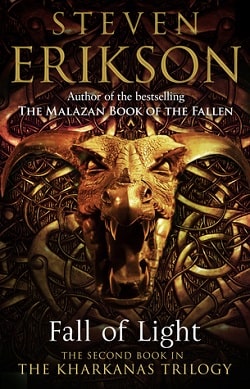
In Fall of Light, the second installment of Steven Erikson's ambitious Kharkanas Trilogy, readers are thrust into a world teetering on the brink of chaos. Set against the backdrop of a bitter winter and a civil war that ravages Kurald Galain, Erikson weaves a complex tapestry of political intrigue, familial loyalty, and the inexorable pull of destiny. The narrative is rich with Erikson's signature blend of epic fantasy and philosophical depth, making it a compelling read for both seasoned fans and newcomers to the Malazan universe.
The story begins with Urusander's Legion preparing to march upon the city of Kharkanas, a city steeped in history and conflict. The absence of Anomander, who has departed in search of his estranged brother Andarist, leaves a power vacuum that Silchas Ruin, the last of the brothers, must navigate. Silchas's quest to gather the Houseblades of the Highborn Noble families and resurrect the Hust Legion is fraught with urgency, as time is not on his side. This theme of time—its passage, its manipulation, and its consequences—permeates the narrative, serving as a reminder of the fleeting nature of power and the inevitability of change.
Erikson excels in character development, and in Fall of Light, he presents a cast that is both diverse and deeply flawed. Silchas Ruin emerges as a tragic hero, burdened by the weight of his family's legacy and the expectations placed upon him. His internal struggles and moral dilemmas resonate with readers, as he grapples with the responsibilities of leadership and the sacrifices required to protect his people. The tension between duty and personal desire is a recurring motif, explored through the relationships he forges and the decisions he makes.
On the opposing side, Hunn Raal and Vatha Urusander represent the militaristic and political ambitions that threaten to engulf Kharkanas. Their desire to cast aside Draconus and wed Vatha to Mother Dark illustrates the lengths to which individuals will go to seize power. The Cult of Light, led by the exiled High Priestess Syntara, adds another layer of complexity to the conflict, as it embodies the struggle between opposing forces—light and dark, order and chaos. This duality is a hallmark of Erikson's writing, and it invites readers to ponder the nature of good and evil in a world where morality is often ambiguous.
As the narrative unfolds, Erikson introduces a host of new characters and factions, each with their own motivations and agendas. The unlikely army gathering in the west, commanded by a grief-stricken Jaghut, serves as a poignant reminder of the personal tragedies that shape the broader conflicts of the world. The arrival of blue-skinned strangers and Toblakai warriors adds a sense of urgency and unpredictability to the unfolding drama, as alliances are forged and broken in the face of an impending war.
One of the most striking aspects of Fall of Light is Erikson's exploration of magic and its consequences. The concept of K'rul, the lifeblood of the Azathanai, running loose and wild, serves as a metaphor for the untamed forces that govern the universe. As K'rul embarks on a quest to bring order to this chaotic magic, readers are reminded of the delicate balance between creation and destruction. The entities that gather in response to this burgeoning power—both new and ancient—underscore the idea that magic is not merely a tool but a living force that shapes the destinies of those who wield it.
Erikson's prose is both lyrical and dense, requiring readers to engage deeply with the text. His world-building is unparalleled, with intricate histories and cultures that enrich the narrative. The author’s ability to weave multiple storylines and perspectives into a cohesive whole is a testament to his skill as a storyteller. However, this complexity may pose a challenge for some readers, particularly those unfamiliar with the Malazan universe. Yet, for those willing to invest the time and effort, the rewards are manifold.
Thematically, Fall of Light delves into the nature of power, the burdens of leadership, and the cyclical nature of history. Erikson invites readers to reflect on the consequences of ambition and the sacrifices made in the name of loyalty and love. The interplay between personal and political struggles is masterfully executed, creating a narrative that is both intimate and grand in scope.
In comparison to other epic fantasy works, Erikson's style is reminiscent of authors like George R.R. Martin and J.R.R. Tolkien, yet he carves out his own niche with a focus on philosophical inquiry and moral ambiguity. While Martin's world is often characterized by its brutal realism and political machinations, Erikson's universe is imbued with a sense of mythic grandeur and existential contemplation. Readers who appreciate the depth of character and the intricacies of world-building will find much to admire in Erikson's work.
In conclusion, Fall of Light is a masterful continuation of the Kharkanas Trilogy that challenges readers to confront the complexities of power, loyalty, and the human condition. With its rich character development, intricate plotlines, and profound themes, Erikson has crafted a narrative that resonates long after the final page is turned. This book is not merely a story; it is an experience that invites readers to lose themselves in a world where the stakes are high, and the consequences of every action reverberate through time.



