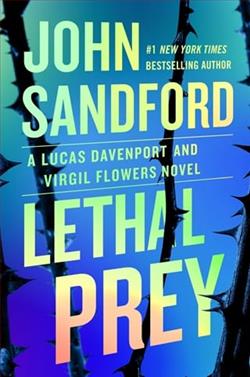
John Sandford’s Lethal Prey is a gripping addition to the world of crime thrillers, bringing together two of his most beloved characters, Lucas Davenport and Virgil Flowers, in a high-stakes investigation that spans decades. The novel is a masterful blend of suspense, character depth, and a plot that keeps readers on the edge of their seats from start to finish.
At the heart of Lethal Prey is the unsolved murder of Doris Grandfelt, a case that has haunted her twin sister, Lara, for twenty years. Sandford expertly uses this cold case as a catalyst for the narrative, weaving a complex tapestry of past and present that challenges both the characters and the readers to piece together the truth. The decision to have Lara, now facing her mortality due to a cancer diagnosis, take matters into her own hands by publicizing the case and offering a substantial reward adds a layer of urgency and emotional depth to the story.
One of the novel’s standout features is its exploration of the impact of time on unresolved trauma. Lara’s relentless pursuit of justice for her sister is not just about closure; it’s about reclaiming control over a life overshadowed by violence and loss. Sandford portrays Lara with a nuanced sensitivity, capturing her desperation, determination, and vulnerability in a way that resonates deeply with the reader. Her character serves as a poignant reminder of the personal toll that unsolved crimes can have on those left behind.
The introduction of true crime bloggers into the narrative is a clever and timely twist. In an era where true crime has become a cultural phenomenon, Sandford taps into the public’s fascination with amateur sleuthing and the power of the internet to crowdsource information. This element not only modernizes the story but also adds an intriguing layer of complexity as the bloggers’ involvement both aids and complicates the investigation. The bloggers’ presence raises questions about the ethics of true crime as entertainment and the potential consequences of publicizing sensitive information, themes that Sandford handles with a deft touch.
Lucas Davenport and Virgil Flowers, as always, are a dynamic duo whose contrasting styles and personalities provide both tension and humor. Davenport’s methodical approach and Flowers’ more intuitive style complement each other perfectly, creating a synergy that drives the investigation forward. Sandford’s ability to develop these characters over multiple books is evident in their rich backstories and the depth of their interactions. Fans of the series will appreciate the continued evolution of their relationship, while new readers will find them instantly engaging and relatable.
The novel’s pacing is impeccable, with Sandford skillfully balancing action, investigation, and character development. The discovery of the murder weapon serves as a pivotal moment in the plot, propelling the narrative into high gear. From this point, the tension escalates as Davenport and Flowers race against time to uncover the killer’s identity. Sandford’s use of short, punchy chapters keeps the momentum going, making it difficult to put the book down.
Sandford’s prose is both sharp and evocative, painting vivid pictures of the Minnesota landscape and the gritty urban settings that serve as the backdrop for the story. His attention to detail enhances the realism of the narrative, immersing the reader in the world he has created. The dialogue is crisp and authentic, capturing the distinct voices of each character and adding depth to their interactions.
Comparatively, Lethal Prey stands out in the genre for its intricate plot and well-drawn characters. While it shares thematic similarities with works by authors like Michael Connelly and Tana French, Sandford’s ability to blend procedural elements with personal stakes gives the novel a unique edge. The interplay between the past and present, coupled with the exploration of the true crime phenomenon, sets it apart from more traditional thrillers.
In conclusion, Lethal Prey is a compelling and thought-provoking addition to John Sandford’s oeuvre. It is a testament to his skill as a storyteller that he can take a seemingly straightforward premise and transform it into a multilayered narrative that challenges and entertains in equal measure. The novel’s exploration of justice, memory, and the relentless pursuit of truth will linger with readers long after they turn the final page. Whether you are a longtime fan of Davenport and Flowers or a newcomer to Sandford’s work, Lethal Prey is a must-read that delivers on every level.



