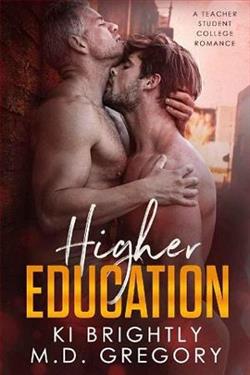
Ki Brightly's Higher Education is a compelling narrative that delves into the complexities of love, privilege, and the pursuit of happiness against societal norms. At its core, the novel is a second-chance romance that explores the intricate dynamics between two seemingly disparate characters: Judge Daughtler, a privileged law student, and Flynn Goddard, a teacher grappling with the aftermath of a long-term relationship's demise.
The novel opens with a chance encounter between Judge and Flynn at a club, setting the stage for a relationship that defies conventional boundaries. Judge, characterized by his confidence and charm, is immediately drawn to Flynn, whose recent heartbreak has left him vulnerable yet cautious. This initial meeting is a catalyst for the unfolding drama, as Judge's determination to pursue Flynn is met with both internal and external challenges.
One of the novel's strengths lies in its character development. Judge Daughtler is initially portrayed as the archetypal jock, accustomed to getting what he wants. However, as the story progresses, Brightly peels back the layers of his character, revealing a depth that goes beyond his privileged exterior. Judge's journey is one of self-discovery, as he learns to navigate the complexities of love and responsibility. His evolution from a cocky law student to a man capable of genuine affection and commitment is both believable and engaging.
Flynn Goddard, on the other hand, is a character marked by his recent emotional turmoil. Having been left by his partner of twenty-five years, Flynn is understandably wary of entering a new relationship, especially with a student. Brightly skillfully portrays Flynn's internal conflict, balancing his desire for companionship with the need to maintain professional boundaries. Flynn's struggle is relatable, and his eventual decision to embrace a relationship with Judge is a testament to his growth and resilience.
The novel's exploration of themes such as privilege, power dynamics, and societal expectations is both timely and thought-provoking. Judge's privileged background is a recurring motif, serving as both a source of tension and a point of introspection. Brightly does not shy away from addressing the implications of Judge's status, particularly in the context of his relationship with Flynn. The power imbalance inherent in their teacher-student dynamic adds an additional layer of complexity, challenging both characters to confront their own biases and assumptions.
Moreover, the theme of second chances is woven throughout the narrative, offering a sense of hope and redemption. Flynn's journey from heartbreak to healing is mirrored by Judge's transformation, as both characters learn to let go of past grievances and embrace the possibility of a future together. This theme is further underscored by the novel's resolution, which, while satisfying, does not shy away from the realities of their situation.
In terms of pacing, Higher Education strikes a balance between introspective moments and engaging dialogue. Brightly's writing is both accessible and nuanced, capturing the emotional depth of the characters while maintaining a sense of momentum. The dialogue is particularly noteworthy, reflecting the characters' personalities and evolving relationship dynamics. The witty exchanges between Judge and Flynn add a layer of levity to the narrative, providing moments of humor amidst the tension.
Comparatively, Higher Education shares thematic similarities with other works in the romance genre, such as Red, White & Royal Blue by Casey McQuiston, which also explores themes of privilege and societal expectations. However, Brightly's novel distinguishes itself through its focus on the teacher-student dynamic, offering a fresh perspective on the challenges and rewards of unconventional relationships.
Overall, Higher Education is a captivating read that offers a nuanced exploration of love, privilege, and personal growth. Brightly's ability to craft complex, relatable characters ensures that readers are invested in Judge and Flynn's journey from start to finish. The novel's blend of romance, humor, and introspection makes it a standout in the genre, appealing to readers who appreciate stories that challenge societal norms while celebrating the transformative power of love.
In conclusion, Ki Brightly's Higher Education is a testament to the enduring appeal of second-chance romances. Through its well-drawn characters and thoughtful exploration of contemporary themes, the novel offers a poignant reminder that love, in all its forms, is worth pursuing, even in the face of adversity. For readers seeking a romance that is both entertaining and thought-provoking, Higher Education is a must-read.



