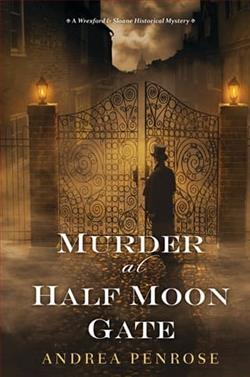
Andrea Penrose's Murder at Half Moon Gate is a captivating historical mystery that seamlessly blends the allure of Regency-era London with the intrigue of a classic whodunit. The novel, a part of the Wrexford & Sloane series, invites readers into a world where scientific innovation meets the shadowy underbelly of society, creating a rich tapestry of suspense and intellectual curiosity.
At the heart of the story is Lord Wrexford, an eminent scientist whose logical mind and keen observational skills make him an unlikely yet effective detective. His discovery of a murdered inventor in a dimly lit alley sets the stage for a complex investigation that challenges both his scientific acumen and his moral compass. Wrexford is a compelling protagonist, characterized by his sharp wit and a certain aloofness that gradually softens as the narrative unfolds. His character development is subtle yet significant, as he navigates the murky waters of human emotion and ethical dilemmas.
Complementing Wrexford is Charlotte Sloane, a fiercely independent woman who defies societal norms by publishing political cartoons under the pseudonym A. J. Quill. Charlotte's character is a breath of fresh air, offering a strong female perspective in a male-dominated world. Her network of informants and her ability to see beyond the surface make her an invaluable ally in the investigation. The dynamic between Wrexford and Charlotte is one of the novel's highlights, as their partnership evolves from one of convenience to a deeper, more nuanced relationship. Their interactions are laced with a delightful mix of banter and mutual respect, adding a layer of complexity to the narrative.
The themes explored in Murder at Half Moon Gate are multifaceted, weaving together elements of scientific progress, social class disparity, and the quest for justice. The missing designs for a steam-powered engine symbolize the era's technological advancements and the potential for both innovation and exploitation. Penrose skillfully uses this motif to explore the ethical implications of scientific discovery, raising questions about who benefits from progress and at what cost. The novel also delves into the societal hierarchies of the time, highlighting the stark contrasts between the privileged elite and the struggling working class. Through characters like the inventor's widow and the ambitious assistants, Penrose paints a vivid picture of a society in flux, grappling with the challenges of modernization.
The plot is intricately woven, with a host of suspects that keep readers guessing until the very end. Penrose's attention to detail is evident in her meticulous depiction of Regency London, from the opulent drawing rooms to the grimy alleyways. The atmospheric setting enhances the mystery, creating a sense of foreboding that permeates the narrative. The pacing is well-balanced, with moments of tension interspersed with quieter, character-driven scenes that allow for introspection and growth.
In comparison to other historical mysteries, such as those by Anne Perry or C. S. Harris, Penrose's work stands out for its unique blend of scientific intrigue and social commentary. While Perry often focuses on the moral complexities of Victorian society and Harris delves into the darker aspects of Regency England, Penrose strikes a balance between the two, offering a narrative that is both intellectually stimulating and emotionally resonant. Her characters are well-drawn and relatable, their struggles and triumphs reflecting the universal human experience.
Overall, Murder at Half Moon Gate is a masterfully crafted mystery that will appeal to fans of historical fiction and detective stories alike. Penrose's ability to create a vivid, immersive world is matched only by her skill in crafting a compelling narrative that keeps readers engaged from start to finish. The novel's exploration of themes such as innovation, justice, and societal change adds depth to the story, making it a thought-provoking read that lingers long after the final page is turned.
For those seeking a mystery that combines the intellectual rigor of a scientific inquiry with the emotional depth of a character-driven narrative, Andrea Penrose's Murder at Half Moon Gate is a must-read. It is a testament to the power of storytelling, offering a window into a bygone era while addressing timeless questions about the nature of progress and the human condition.



