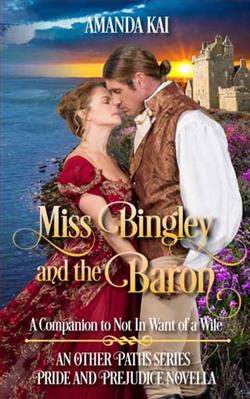
Amanda Kai's Miss Bingley and the Baron is a delightful exploration of social ambition, identity, and the transformative power of love, set against the familiar backdrop of Regency England. As a companion novella to Not In Want of a Wife, it stands robustly on its own, offering readers a fresh perspective on a character often relegated to the sidelines in Jane Austen's Pride and Prejudice.
At the heart of this novella is Miss Caroline Bingley, a character who, in Austen's original work, is often portrayed as the quintessential social climber. Kai takes this familiar figure and imbues her with depth and nuance, allowing readers to see beyond her superficial ambitions. Caroline's journey is one of self-discovery, as she grapples with the societal pressures to marry well and the personal desire for genuine affection and respect.
Caroline's initial motivation is clear: she seeks to escape the 'stench of trade' associated with her father's mercantile background by marrying into the aristocracy. Her determination to secure a wealthy husband is both a reflection of her personal aspirations and a commentary on the limited avenues available to women of her time. Kai skillfully uses Caroline's character to explore themes of class and social mobility, highlighting the rigid structures that defined Regency society.
Enter Lord Theodore Connally, a baron with a fortune that eclipses even Mr. Darcy's. Theo is a character who, despite his wealth, is wary of those who might seek to exploit it. His recent return from the Grand Tour and the loss of his father have left him cautious and introspective. Theo's decision to disguise himself as a gardener to test Caroline's intentions is a clever narrative device that adds layers of intrigue and humor to the story.
The mistaken identity trope is a classic in romantic literature, and Kai employs it with finesse. The interactions between Caroline and Theo, under the guise of the gardener, are some of the novella's most engaging moments. Through these encounters, Caroline's character is allowed to shine, revealing a warmth and wit that are often overshadowed by her social ambitions. Theo, too, is given the opportunity to see beyond Caroline's facade, discovering a woman who is both intelligent and compassionate.
The supporting characters, particularly Theo's friend, the gardener's son, who assumes the role of the baron, add depth and humor to the narrative. Their involvement in the ruse not only serves to advance the plot but also provides a commentary on the fluidity of identity and the arbitrary nature of social status. This theme is reminiscent of works by authors like Georgette Heyer, who similarly explore the complexities of identity and class in their Regency romances.
As the story unfolds, Caroline is faced with a choice that challenges her initial motivations. The proposal from the 'baron' forces her to confront her true desires and question what truly matters in a partner. This moment of introspection is a turning point for Caroline, marking her growth from a character driven by societal expectations to one who values personal happiness and integrity.
Kai's writing is both engaging and accessible, capturing the essence of the Regency period while infusing it with a modern sensibility. Her dialogue is sharp and witty, reminiscent of Austen's own style, yet distinct in its voice. The pacing of the novella is well-balanced, allowing for both character development and plot progression without feeling rushed.
One of the novella's strengths is its ability to stand alone while also serving as a companion piece to Not In Want of a Wife. Readers familiar with Kai's previous work will appreciate the continuity and depth it adds to her literary universe, while newcomers will find it an inviting entry point into her storytelling.
In comparison to other Regency romances, Miss Bingley and the Baron holds its own with its unique take on a familiar character and its exploration of themes that resonate with contemporary audiences. The novella's focus on identity, class, and personal growth is reminiscent of works by authors like Mary Balogh and Julia Quinn, who similarly blend historical settings with timeless themes.
Overall, Miss Bingley and the Baron is a charming and thought-provoking read that offers a fresh perspective on a beloved literary world. Amanda Kai's ability to breathe new life into a character like Caroline Bingley is a testament to her skill as a writer and her understanding of the complexities of human nature. This novella is sure to delight fans of Regency romance and those who appreciate stories of personal transformation and the enduring power of love.



