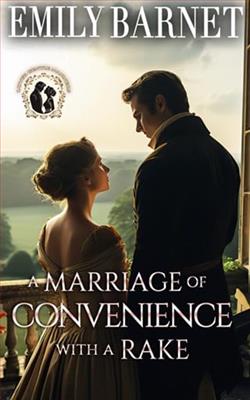
Emily Barnet's A Marriage of Convenience with a Rake is a delightful foray into the world of Regency romance, where societal expectations and personal desires often find themselves at odds. The novel deftly explores themes of love, duty, and redemption, all while weaving a narrative that is both engaging and emotionally resonant.
At the heart of the story is Lady Eleanor Montague, a character who defies the typical constraints of her time. Eleanor is fiercely independent, a trait that sets her apart from many of her contemporaries in the genre. Her unwillingness to conform to societal norms is not just a character quirk but a driving force in the narrative. Barnet crafts Eleanor with a depth that makes her both relatable and admirable. Her journey from a woman forced into an arranged marriage to one who finds her own path is a testament to her resilience and strength.
Opposite Eleanor is Lord Sebastian Thornton, the quintessential rake with a reputation that precedes him. However, Barnet does not allow Sebastian to remain a one-dimensional character. Instead, she peels back the layers of his rakish exterior to reveal a man scarred by his past. This transformation is gradual and believable, making his character arc one of the most compelling aspects of the novel. As Eleanor begins to chip away at the walls around his heart, readers are treated to a nuanced portrayal of a man learning to confront his demons and embrace vulnerability.
The arranged marriage between Eleanor and Sebastian serves as the catalyst for the story, but it is the hidden agenda behind their union that adds an intriguing layer of complexity. The revelation of a decades-old family feud and the elders' hope to mend these fractured bonds through the marriage of their grandchildren is a clever narrative device. It not only provides a rich backstory but also raises the stakes for Eleanor and Sebastian as they navigate their new life together.
One of the novel's strengths lies in its exploration of the tension between personal desires and societal expectations. Eleanor and Sebastian's differing views on love and duty create a dynamic that is both entertaining and thought-provoking. Their clashes are not just about their relationship but also about the broader societal norms that dictate their lives. Barnet uses these conflicts to delve into the characters' internal struggles, making their eventual reconciliation all the more satisfying.
In terms of themes, A Marriage of Convenience with a Rake is a meditation on the power of love to heal and transform. The novel suggests that love is not just a romantic ideal but a force that can bridge divides and mend broken relationships. This is particularly evident in the way Eleanor and Sebastian's relationship evolves. Their journey from reluctant partners to a couple who genuinely care for each other is a testament to the transformative power of love.
The novel also tackles the theme of redemption, particularly through Sebastian's character. His journey from a notorious rake to a man capable of love and commitment is a classic redemption arc, but Barnet handles it with a deft touch. She avoids clichés and instead presents a realistic portrayal of a man grappling with his past and striving to become better.
Comparatively, Barnet's work stands alongside other Regency romances such as Julia Quinn's Bridgerton series and Lisa Kleypas's Wallflowers series. Like Quinn and Kleypas, Barnet excels in creating a vivid historical setting that feels authentic and immersive. Her attention to detail in depicting the societal norms and expectations of the time adds depth to the narrative and enhances the reader's engagement with the story.
However, what sets Barnet apart is her focus on character development. While many Regency romances rely heavily on plot-driven narratives, Barnet places her characters at the forefront. This emphasis on character growth and emotional depth makes A Marriage of Convenience with a Rake a standout in the genre.
Overall, Emily Barnet's A Marriage of Convenience with a Rake is a captivating read that will appeal to fans of Regency romance and beyond. Its exploration of love, duty, and redemption is both timeless and timely, offering readers a story that is as emotionally satisfying as it is entertaining. With well-drawn characters and a compelling narrative, this novel is a testament to Barnet's skill as a storyteller and her ability to breathe new life into familiar tropes.



