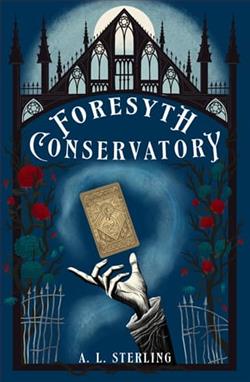
A.L. Sterling's Foresyth Conservatory is a captivating blend of dark academia and mystery, weaving together elements of the occult with a gripping narrative that keeps readers on the edge of their seats. The novel's blurb draws intriguing comparisons to Ninth House and Mexican Gothic, and it does not disappoint in delivering a story that is both haunting and intellectually stimulating.
At the heart of the story is Dahlia Blackburne, a character who is as complex as she is relatable. As a failing bookstore owner and a fake Tarot reader, Dahlia's life is already steeped in the mystical, albeit through a lens of skepticism. Her reliance on deduction rather than magic to cast fortunes sets the stage for a narrative that questions the boundaries between reality and the supernatural. This theme is further explored when Dahlia is approached by the enigmatic Meister, who offers her a dangerous yet lucrative proposition: infiltrate the elite Foresyth Conservatory to investigate the alleged suicide of a student, Julian Earhardt.
The setting of Foresyth Conservatory is richly described, with its candlelit halls and ivy-choked towers creating an atmosphere that is both enchanting and foreboding. Sterling's ability to craft such a vivid backdrop enhances the novel's dark academia aesthetic, drawing readers into a world where knowledge comes at a steep price. The Conservatory itself is a character in its own right, with its secrets and mysteries waiting to be unraveled.
Character development is one of the novel's strongest points. Dahlia's journey from a skeptical Tarot reader to a determined investigator is compelling, and her motivations are deeply rooted in her personal struggles, particularly her need to care for her ailing mother. This adds a layer of emotional depth to her character, making her decisions and actions resonate with authenticity. The supporting characters, including the alluring "Trees" Sequoia and Aspen, are equally well-developed, each with their own motivations and secrets that add complexity to the narrative.
The novel's exploration of themes such as the cost of knowledge, the blurred line between performance and passion, and the inheritance of magic is both thought-provoking and engaging. Sterling delves into the idea that magic is not just a learned skill but something that can be inherited, a concept that challenges traditional notions of power and ability. This theme is intricately tied to Dahlia's personal journey, as she uncovers the truth about her father's history and its connection to the Conservatory.
In terms of pacing, Foresyth Conservatory strikes a delicate balance between suspense and revelation. The mystery surrounding Julian's death unfolds gradually, with each chapter offering new clues and insights that keep readers guessing. Sterling's writing is both lyrical and precise, capturing the tension and intrigue of the story while maintaining a sense of elegance and sophistication.
Comparatively, fans of Leigh Bardugo's Ninth House and Silvia Moreno-Garcia's Mexican Gothic will find much to appreciate in Foresyth Conservatory. Like Bardugo, Sterling crafts a narrative that is steeped in the supernatural, yet grounded in the real-world struggles of its protagonist. Similarly, the gothic elements and atmospheric setting echo Moreno-Garcia's ability to create a sense of unease and mystery.
Overall, Foresyth Conservatory is a masterful addition to the dark academia genre, offering a story that is as intellectually stimulating as it is emotionally resonant. A.L. Sterling has crafted a novel that challenges readers to question the nature of magic, knowledge, and the lengths one will go to uncover the truth. With its richly drawn characters, evocative setting, and intricate plot, Foresyth Conservatory is a must-read for anyone who enjoys a mystery that is as dark as it is enlightening.
In conclusion, the cards at Foresyth have indeed been dealt, and Sterling invites readers to play their hand in a game where the stakes are high, and the rewards are as tantalizing as they are dangerous. This novel is a testament to the power of storytelling, where the line between reality and magic is not just blurred but beautifully intertwined.



