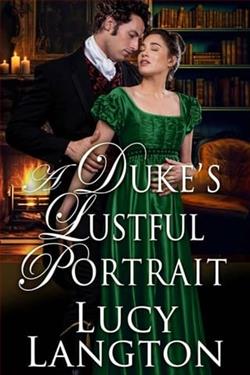
Lucy Langton’s A Duke's Lustful Portrait is a captivating historical romance that weaves together themes of art, passion, and societal constraints with a deft hand. Set against the backdrop of the secretive and scandalous Lord’s Society, the novel explores the intricate dance between desire and duty, love and revenge. Langton’s narrative is rich with emotional depth and vivid imagery, making it a compelling read for fans of the genre.
At the heart of the story is Lady Arabella Sinclair, a character who embodies the struggle between personal ambition and societal expectations. Arabella is a gifted painter, yet she finds herself confined within the rigid structures of the ton, where her talents are both celebrated and stifled. Her longing to escape to the French countryside to pursue her true passion for landscape painting is a poignant reflection of her desire for freedom and self-expression. Langton skillfully portrays Arabella’s internal conflict, making her a relatable and sympathetic protagonist. Her journey is not just one of romantic discovery but also of personal empowerment, as she learns to assert her own desires in a world that seeks to define her.
Enter Sebastian Ravenswood, the brooding Duke whose presence disrupts Arabella’s carefully constructed world. Sebastian is a character driven by a thirst for vengeance, seeking justice for his mother’s murder. His infiltration of the Lord’s Society is a means to an end, yet it becomes the catalyst for an unexpected and transformative romance. Langton crafts Sebastian as a complex figure, torn between his dark past and the possibility of a brighter future. His interactions with Arabella are charged with tension and chemistry, as their relationship evolves from one of mutual intrigue to deep, abiding love.
The chemistry between Arabella and Sebastian is palpable, and Langton excels in building a romance that feels both inevitable and fraught with obstacles. Their love story is a testament to the power of vulnerability and trust, as both characters must confront their own fears and insecurities. The author’s ability to balance the sensual with the emotional is particularly noteworthy, creating a narrative that is as much about the heart as it is about desire.
One of the novel’s standout features is its exploration of the Lord’s Society, a clandestine world of vice and intrigue. Langton paints this setting with a vivid brush, imbuing it with a sense of mystery and danger. The society serves as both a backdrop and a catalyst for the unfolding drama, its secrets and machinations adding layers of complexity to the plot. The tension between public propriety and private indulgence is a recurring theme, highlighting the hypocrisy and double standards of the era.
Langton’s prose is both elegant and evocative, capturing the nuances of the period while maintaining a modern sensibility. Her attention to detail is evident in the lush descriptions of Arabella’s art and the opulent settings of the ton. The novel’s pacing is well-judged, with moments of introspection balanced by scenes of high drama and passion. The dialogue is sharp and engaging, revealing character and advancing the plot with skill.
In terms of character development, both Arabella and Sebastian undergo significant growth over the course of the novel. Arabella’s journey towards self-acceptance and artistic freedom is mirrored by Sebastian’s path to redemption and emotional openness. Their individual arcs are satisfying and well-realized, culminating in a conclusion that feels both earned and uplifting. The supporting cast, while not as deeply explored, adds texture and depth to the narrative, providing a broader context for the central romance.
Comparatively, A Duke's Lustful Portrait shares thematic similarities with the works of authors like Tessa Dare and Sarah MacLean, who also explore the tension between societal expectations and personal desires in their historical romances. However, Langton’s focus on the world of art and the unique setting of the Lord’s Society sets her novel apart, offering readers a fresh perspective within the genre.
Ultimately, A Duke's Lustful Portrait is a richly layered and emotionally resonant novel that will appeal to readers who appreciate historical romance with depth and substance. Langton’s ability to blend romance with themes of art, identity, and societal constraint results in a story that is both entertaining and thought-provoking. With its compelling characters and evocative setting, the novel is a testament to the enduring power of love to transcend even the most formidable barriers.
For those seeking a romance that is as much about personal growth as it is about passion, Lucy Langton’s latest offering is a must-read. It is a story that lingers in the mind, inviting reflection on the nature of love, art, and the courage to defy convention in pursuit of one’s true self.



