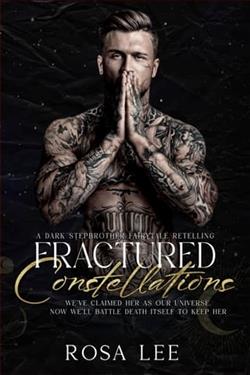
Rosa Lee's Fractured Constellations is a compelling exploration of forbidden love, familial complexities, and the relentless battle against mortality. The novel weaves a narrative that is as emotionally charged as it is provocative, challenging readers to confront their own perceptions of love, loyalty, and the human spirit's resilience.
At the heart of this story is the protagonist, a young woman who finds herself entangled in a web of emotions with her three stepbrothers, Chase, Blade, and Thorn. Each of these characters is meticulously crafted, offering a unique perspective on the themes of love and redemption. Chase, with his calculating and ruthless demeanor, represents the cold logic that often accompanies survival. Blade, clinical and unforgiving, embodies the harsh realities of life and the barriers we erect to protect ourselves. Thorn, whose smile hides venom, is a testament to the duality of human nature, where kindness and cruelty coexist.
The novel's central theme revolves around the transformative power of love. Initially, the triplet brothers are antagonistic, their contempt for the protagonist palpable. However, as the story unfolds, their hatred morphs into a fierce devotion, illustrating how love can emerge from the most unlikely of circumstances. This transformation is not only pivotal to the character development but also serves as a metaphor for the healing power of love, even in the face of impending death.
One of the most striking aspects of Fractured Constellations is its unflinching portrayal of illness. The protagonist's battle with cancer is depicted with raw honesty, capturing the physical and emotional toll it takes on her. Lee does not shy away from the harsh realities of living with a terminal illness, yet she balances this with moments of tenderness and hope. The juxtaposition of the protagonist's vulnerability with the brothers' protective instincts creates a dynamic that is both heart-wrenching and heartwarming.
The narrative is further enriched by the underlying tension between the protagonist and her stepfather, Richard Banks. His schemes to control the family add an additional layer of conflict, highlighting the theme of power and control. This subplot serves as a catalyst for the protagonist's growth, forcing her to confront her fears and assert her autonomy.
Lee's writing is both lyrical and evocative, drawing readers into the emotional depths of her characters' experiences. Her use of vivid imagery and poignant dialogue enhances the story's impact, making it a deeply immersive read. The title, Fractured Constellations, is a fitting metaphor for the characters' lives—each a broken piece of a larger whole, striving to find their place in the universe.
In comparison to other works in the genre, such as Penelope Douglas's Punk 57 or L.J. Shen's Vicious, Lee's novel stands out for its nuanced exploration of illness and its impact on relationships. While both Douglas and Shen delve into themes of forbidden love and redemption, Lee's focus on the protagonist's battle with cancer adds a layer of depth and urgency that is both unique and compelling.
Overall, Fractured Constellations is a powerful testament to the resilience of the human spirit. It challenges readers to consider the complexities of love and the lengths we will go to protect those we care about. The novel's emotional depth and richly developed characters make it a standout in the realm of contemporary romance, offering a poignant reminder that even in the face of death, love can be a guiding light.
For readers seeking a story that is both thought-provoking and emotionally resonant, Fractured Constellations is a must-read. Rosa Lee has crafted a narrative that not only entertains but also inspires, leaving a lasting impression long after the final page is turned.



