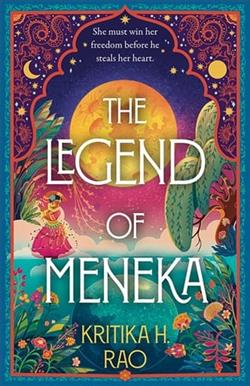
Kritika H. Rao's The Legend of Meneka is an enchanting tapestry of myth, romance, and self-discovery, drawing inspiration from one of Hindu mythology's most enduring tales. The novel deftly explores the intricate dance between duty and desire, loyalty and love, through the eyes of its protagonist, Meneka, a celestial dancer or apsara. Rao's narrative is a lush exploration of identity and agency, set against the backdrop of a world where the mortal and immortal realms intertwine.
At the heart of the story is Meneka, a character who is both a weapon and a woman, trained to seduce and manipulate for the political machinations of Lord Indra, the king of heaven. Rao paints Meneka with a complexity that is both refreshing and engaging. She is not merely a pawn in the celestial game but a warrior with her own desires and dreams. Her internal conflict is palpable as she grapples with the moral implications of her missions and her yearning for freedom. This tension is the driving force of the narrative, making Meneka a compelling and relatable character.
The novel's thematic exploration of freedom versus duty is particularly poignant. Meneka's struggle to reconcile her obligations with her personal desires mirrors the universal human quest for autonomy. Rao skillfully uses Meneka's journey to question the nature of power and control, both personal and political. The apsara's seduction missions, while seemingly glamorous, are revealed to be a form of bondage, highlighting the often-overlooked cost of beauty and allure. This theme resonates deeply, inviting readers to reflect on their own lives and the societal expectations that bind them.
Rao's portrayal of the relationship between Meneka and the sage Kaushika is another highlight of the novel. Their dynamic is a beautifully crafted dance of attraction and resistance, where each character challenges and transforms the other. Kaushika, with his growing powers and empathetic nature, serves as a catalyst for Meneka's awakening. He embodies the possibility of a different kind of power—one rooted in understanding and compassion rather than dominance. Their evolving relationship is a testament to the transformative power of love, a theme that Rao explores with sensitivity and depth.
The novel's setting, straddling the mortal and immortal realms, is richly imagined and vividly described. Rao's world-building is meticulous, with each realm possessing its own unique characteristics and rules. The celestial realm, with its opulence and intrigue, contrasts sharply with the earthy simplicity of the mortal world. This dichotomy serves to underscore the novel's exploration of duality and balance, themes that are central to the story's mythological roots.
Rao's prose is both lyrical and precise, capturing the ethereal beauty of the apsaras and the visceral intensity of Meneka's emotions. Her writing is imbued with a sense of wonder and magic, drawing readers into a world that feels both fantastical and familiar. The narrative is well-paced, with moments of introspection balanced by scenes of action and tension. Rao's ability to weave together the personal and the epic is a testament to her skill as a storyteller.
In comparing The Legend of Meneka to other works inspired by Hindu mythology, such as Chitra Banerjee Divakaruni's The Palace of Illusions or Amish Tripathi's Shiva Trilogy, Rao's novel stands out for its focus on the inner life of its protagonist. While Divakaruni and Tripathi explore the grand narratives of mythological figures, Rao delves into the personal journey of a character often relegated to the sidelines. This focus on the individual within the mythological framework adds a layer of intimacy and immediacy to the story, making it resonate on a personal level.
Overall, The Legend of Meneka is a captivating exploration of love, power, and self-discovery. Rao's ability to blend mythological elements with contemporary themes results in a narrative that is both timeless and timely. The novel invites readers to question the roles they play in their own lives and the choices they make in the pursuit of freedom and fulfillment. It is a story that lingers long after the final page is turned, a testament to the enduring power of myth and the human spirit.
For readers seeking a story that combines the magic of mythology with the depth of character-driven narrative, The Legend of Meneka is a must-read. It is a novel that not only entertains but also challenges and inspires, offering a fresh perspective on a classic tale. Kritika H. Rao has crafted a work that is both a tribute to the past and a beacon for the future, a story that speaks to the heart and the soul.



