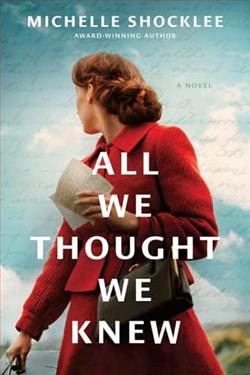
Michelle Shocklee’s All We Thought We Knew is a poignant exploration of family secrets, personal discovery, and the complexities of love and loss. Set against the backdrop of two significant periods in American history—the Vietnam War and World War II—this novel intricately weaves together the lives of two women, Mattie Taylor and Ava Delaney, whose stories are separated by decades yet bound by the threads of family and fate.
The novel opens in 1969, a time of social upheaval and personal turmoil for Mattie Taylor. The loss of her twin brother, Mark, in Vietnam has left a gaping void in her life. Mark was not just her sibling but her confidant and the one person who truly understood her. Shocklee captures Mattie’s grief with a raw authenticity that resonates deeply with anyone who has experienced the loss of a loved one. The emotional depth of Mattie's character is further explored when she returns home upon learning of her mother's impending death. Her journey back home is not just a physical return but a metaphorical one, as she is forced to confront the unresolved issues with her father, whom she blames for Mark’s death.
Mattie’s mother’s dying wish—that she read a collection of old letters—serves as the catalyst for the unfolding mystery and the novel’s central theme: the search for truth and understanding. These letters, from people Mattie has never heard of, promise to unravel the family history she thought she knew. Shocklee masterfully uses this narrative device to bridge the past and present, creating a tapestry of interconnected stories that reveal the hidden facets of Mattie’s family history.
In parallel, the narrative transports us to 1942, where we meet Ava Delaney, a young widow grappling with the aftermath of her husband’s death at Pearl Harbor. Ava’s story is one of resilience and courage, set against the backdrop of a secluded Tennessee farm and a nation at war. Shocklee paints a vivid picture of Ava’s life, capturing the isolation and societal expectations of the time. Ava’s decision to work at a nearby military base introduces her to the controversial practice of housing German nationals classified as enemy aliens. It is here that she meets Gunther Schneider, a gentle and kind German who challenges her preconceived notions of the enemy.
The relationship between Ava and Gunther is a testament to Shocklee’s ability to craft complex, believable characters whose interactions are both heartwarming and thought-provoking. Their friendship, and the burgeoning feelings that develop, highlight the novel’s exploration of love in the face of societal prejudice and personal risk. Ava’s internal conflict—whether to follow her heart or adhere to societal norms—mirrors the broader themes of the novel, questioning the nature of loyalty, justice, and the courage to defy convention.
Shocklee’s writing is both evocative and immersive, drawing readers into the emotional landscapes of her characters. Her ability to seamlessly transition between the two timelines is a testament to her narrative skill, ensuring that each storyline is given equal weight and depth. The dual narratives are not merely parallel but intersect in meaningful ways, as Mattie’s discovery of Ava’s letters reveals the hidden connections between their lives.
Thematically, All We Thought We Knew delves into the complexities of identity, the impact of war on personal lives, and the enduring power of love and forgiveness. Shocklee’s exploration of these themes is nuanced and thought-provoking, encouraging readers to reflect on their own perceptions of history and family. The novel’s title itself is a reflection of its central question: How much do we truly know about the people we love, and how do the stories we inherit shape our understanding of ourselves?
In comparison to other historical fiction, such as Kristin Hannah’s The Nightingale or Anthony Doerr’s All the Light We Cannot See, Shocklee’s novel stands out for its intimate portrayal of personal histories against the backdrop of larger historical events. While Hannah and Doerr focus on the broader impact of war, Shocklee hones in on the personal, crafting a narrative that is both specific in its detail and universal in its themes.
Overall, All We Thought We Knew is a beautifully crafted novel that resonates on multiple levels. Michelle Shocklee has created a compelling narrative that is as much about the past as it is about the present, inviting readers to question their own assumptions and consider the untold stories that shape our lives. This novel is a must-read for fans of historical fiction and anyone interested in the intricate dance of family, memory, and identity.



