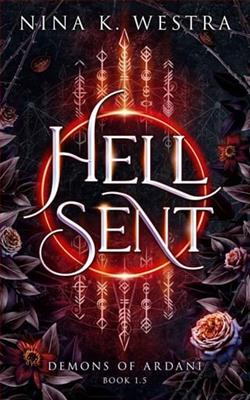
Nina K. Westra's Hell Sent is a captivating novella that delves into the complexities of trust, love, and redemption, set against the backdrop of a fantastical world where demons and humans coexist under strained circumstances. This story, a retelling of Demon Bound from the perspective of Azreth, offers readers a fresh lens through which to explore the intricate dynamics of its characters and the world they inhabit.
At the heart of Hell Sent is Azreth, a demon who embodies the quintessential anti-hero. His life has been a solitary journey, marked by the harsh realities of his existence as a demon. The narrative begins with Azreth imprisoned on the mortal plane, bound to a human lord whose cruelty knows no bounds. This setup immediately establishes a tension-filled environment, drawing readers into a world where survival is a constant struggle and alliances are forged out of necessity rather than trust.
The introduction of the lord's wife, a character who remains unnamed in the blurb but is pivotal to the story, adds a layer of complexity to Azreth's predicament. Her offer to help Azreth in exchange for protection is a turning point in the narrative. Despite her small stature, her intellect and resilience shine through, making her a compelling counterpart to Azreth's brooding and guarded nature. Their relationship is the cornerstone of the novella, exploring themes of mutual healing and self-acceptance.
Westra's portrayal of Azreth is particularly noteworthy. He is described as a "prickly cinnamon roll hero," a term that perfectly encapsulates his rough exterior and the softer, more vulnerable aspects of his character that gradually emerge. This duality makes Azreth a fascinating character to follow, as readers witness his internal struggle between his demonic instincts and the burgeoning emotions he feels towards the human woman who dares to show him kindness.
The theme of trust is intricately woven throughout the narrative. Azreth's initial skepticism towards the woman's intentions is palpable, and his journey towards accepting her help and, eventually, her love is both poignant and rewarding. Westra skillfully navigates the delicate balance between suspicion and vulnerability, creating a narrative tension that keeps readers engaged.
Moreover, the novella does not shy away from exploring the darker aspects of its world. The violence and cruelty that Azreth and the woman endure are depicted with unflinching honesty, serving as a stark reminder of the stakes involved in their quest for freedom. These elements, while intense, are integral to the story's impact, highlighting the resilience and strength required to overcome such adversity.
In terms of character development, both Azreth and the woman undergo significant transformations. Azreth's journey from a solitary demon to a being capable of love and trust is mirrored by the woman's evolution from a mistreated wife to a formidable force in her own right. Their growth is not only a testament to their individual strengths but also to the power of their partnership.
Westra's writing is both evocative and immersive, drawing readers into a richly imagined world where the lines between good and evil are blurred. The spicy romance elements are tastefully integrated, adding depth to the characters' relationship without overshadowing the broader themes of the story. These scenes are crafted with care, ensuring they enhance rather than detract from the narrative's emotional core.
Comparatively, Hell Sent shares thematic similarities with other works in the fantasy romance genre, such as Sarah J. Maas's A Court of Thorns and Roses series, where complex characters navigate love and trust in a world fraught with danger. However, Westra's novella stands out for its focus on a demon protagonist, offering a unique perspective that challenges traditional notions of heroism and morality.
Overall, Hell Sent is a compelling addition to the fantasy romance genre, offering a nuanced exploration of love, trust, and redemption. Its well-developed characters and richly detailed world make it a must-read for fans of the genre, particularly those who appreciate stories that delve into the complexities of human (and demon) emotion. Westra's ability to craft a narrative that is both heart-wrenching and hopeful is a testament to her skill as a storyteller, leaving readers eagerly anticipating her next work.



