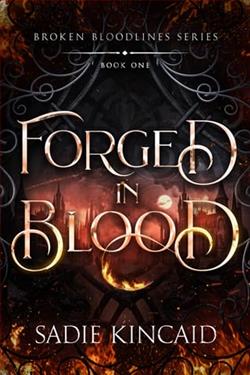
Forged in Blood, a thrilling fantasy novel by Sadie Kincaid, elegantly weaves a tale of intrigue, loyalty, and the relentless quest for power. Set in a meticulously crafted world where magic and political stratagems collide, Kincaid's narrative prowess shines as she delves deep into the heart of conflict and the complexities of human (and non-human) nature. This review aims to dissect the finer points of the book, focusing on its characters, world-building, plot, and thematic elements.
The story kicks off in the Kingdom of Eldoria, a realm teetering on the brink of war. At the center of this impending chaos is the protagonist, Eryn, a fierce warrior with a mysterious past. She is part of an ancient order known as the Blood Guard, whose members derive their powers from a mystical bond with blood. The novel opens with a dramatic scene where Eryn thwarts an assassination attempt on the royal family, setting the tone for a high-stakes narrative filled with suspense and complex moral dilemmas.
One of Kincaid’s greatest strengths in Forged in Blood is her ability to craft multidimensional characters. Eryn, with her brooding demeanor and lethal prowess, is far from a one-dimensional warrior. Her internal conflicts, driven by a haunted past and her duty to protect a kingdom that fears her kind, add layers to her character that are slowly peeled away as the story progresses. The secondary characters, too, from the charming Prince Liam to the cunning mage Taryn, are given depth and motives that intertwine beautifully with the main storyline.
The world of Eldoria is painted with a rich palette of cultures, lore, and history. Kincaid’s world-building is meticulous, creating a universe where different kingdoms have distinct political agendas, cultures, and conflicts. This diversity adds a real sense of scale to the story and provides a compelling backdrop for the characters’ actions. The Magic System, central to the plot, is both unique and well-defined. Kincaid avoids common fantasy clichés, opting instead for a system where the power is literally in the blood, leading to powerful imagery and implications that keep the reader pondering even when the book is closed.
The plot of Forged in Blood is robust, with a pace that escalates smoothly from slow-burning intrigue to full-blown combat and confrontation. Every chapter adds a new layer of tension, making it a hard book to put down. Kincaid masterfully maintains a balance between action sequences and quieter, more introspective moments. These periods of calm are not just fillers; rather, they provide crucial insight into character development and the socio-political complexities of Eldoria. The twists are well-timed and often surprising, though never far-fetched, which is a testament to Kincaid’s plotting skills.
Thematically, Forged in Blood explores themes of power and corruption, loyalty, and the idea of predestination versus free will. Eryn’s struggles revolve around her predetermined role as a member of the Blood Guard and her desire to forge her own path. This internal battle mirrors the larger, external conflicts in the story, creating a resonant narrative that challenges the characters and the reader to think about the nature of power and its effects. The subtler, philosophical undertones do not overshadow the story but rather enrich it, offering several layers of meaning to be decoded by the reader.
Despite its many strengths, the novel isn’t without minor flaws. At times, the pacing suffers slightly from the sheer amount of detail Kincaid pours into her world-building, particularly in the early chapters where the reader might feel overwhelmed with information. However, as the narrative progresses, these details start to form a vivid tapestry that fully immerses the reader in the story.
In conclusion, Forged in Blood by Sadie Kincaid is a standout fantasy novel that offers everything a reader could want: a compelling protagonist, a richly detailed world, a gripping plot, and thoughtful themes. While it demands the reader's attention and engagement, particularly in the early chapters, those who stick with it are rewarded with a deeply satisfying narrative arc and a lingering impact that goes beyond the last page. This book is highly recommended for fans of complex high fantasy, and for those who relish stories where characters are as meticulously crafted as the world they inhabit.



