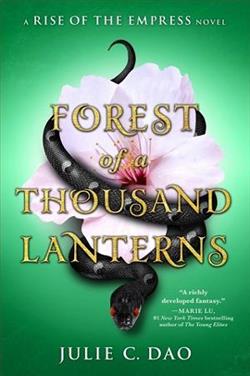
Forest of a Thousand Lanterns by Julie C. Dao is an ambitious and richly woven piece of fantasy literature, etching its mark within the genre with its dark allure and complex characterization. This novel, the first in the "Rise of the Empress" series, presents a unique reimagining of the Evil Queen legend, imbued with the mystique and culture of an East Asian-inspired world. Dao’s storytelling prowess shines through a narrative that is as deeply captivating as it is foreboding, crafting a tale not just about the ascension of an empress, but about the moral descent of a woman consumed by a hunger for power.
The story follows Xifeng, a young woman destined for greatness—foretold by the cards her grandmother Guma reads. Born in a humble village, Xifeng harbors dreams that reach far beyond its confines, fueled by the prophecy that she could someday become Empress of Feng Lu. However, the path to the throne is sodden with darkness; it’s not through mere ambition, but through the murky ethics of witchcraft and the supernatural, guided by a mysterious force within her. The novel thrives on Xifeng’s internal struggle, as she oscillates between surrendering to her cruel fate and clinging to the vestiges of her humanity. Her journey is not just physical but intensely psychological, offering readers a front-row seat to her transformation from an innocent girl into a ruthlessly ambitious woman.
The element that sets Forest of a Thousand Lanterns apart is its unapologetic embrace of the anti-heroine. Xifeng is a protagonist that defies the traditional mold of fantasy heroines. Her beauty and intelligence are overshadowed by her ambition and the malevolent means she employs to secure her destiny. The brilliance of Dao’s character construction lies in her ability to foster both empathy and revulsion for Xifeng, creating a complex emotional landscape for readers to navigate. It provides a fresh perspective and a richer story, breaking conventional dichotomies of good and evil.
Dao does not only excel in character development. The world of Feng Lu emerges almost as a character of its own, painted vividly through lush descriptions and intricate lore. The imperial setting is breathtaking, yet peppered with an undercurrent of darkness and decay that mirrors Xifeng's moral journey. Each province and creature in this brilliantly crafted world pulses with its own energy and history, enhancing the overall narrative with a setting that feels expansive and real.
However, one of the most remarkable facets of Dao's writing is her exploration of themes that resonate deeply with the human condition. Issues of destiny versus choice, the corrupting influence of power, and the complex interplays of female beauty, power, and agency are woven seamlessly into the storyline, prompting readers to ponder these themes long after the last page is turned. A particularly poignant narrative thread is Xifeng’s struggle with her appearance; her beauty is both her weapon and her cage, illustrating the double-edged sword of female beauty ideals.
The pacing of the novel might pose a challenge for some. The gradual build-up, while rich in necessary character and world development, may not cater to those seeking immediate action or quick plot progression. Yet, for those willing to immerse themselves into the depths of Dao's expansive setting and complex heroine, the payoff is immensely satisfying. It allows for a fuller understanding and appreciation of the novel's climactic twists and the moral complexities of its lead.
In conclusion, Julie C. Dao’s Forest of a Thousand Lanterns is a bold, immersive tapestry of fairy tale, mythology, and horror, cast in the shadows of an East Asian-inspired world. It directs the spotlight onto a protagonist whose darkness is as compelling as it is unsettling, challenging readers’ alliances and moral judgments. For lovers of character-driven narratives, intricate world-building, and tales that blur the lines between good and evil, Dao’s work promises an enthralling, although sometimes unnerving, escape. The book not only serves as a memorable debut for Dao but also as a powerful statement on the allure and danger of unchecked ambition.



