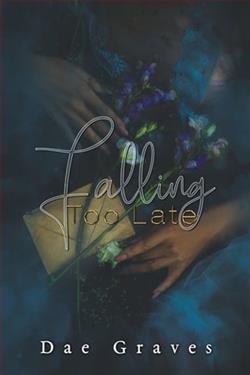
Falling Too Late by Dae Graves is a poignant exploration of love, regret, and the paths not taken. The novel sweeps across the landscapes of human emotion, delicately unraveling the complexities of a love story that is as heart-wrenching as it is beautiful. Set in the scenic town of Almsbury, the narrative follows protagonist Elisa Hartley, a woman caught between the life she’s chosen and the life she could have had.
The book begins as Elisa returns to her hometown for the first time in over a decade. Almsbury, with its cobblestone streets and whispers of the past, serves as a character in its own right, painting a nostalgic picture of small-town life. Here, among the golden hues of autumn, Elisa encounters her former love, Martin Blake, who is now the owner of the local bookstore. Their reunion sets off a series of events that forces Elisa to confront her past decisions and the future she envisaged for herself.
Graves employs a dual timeline narrative technique, seamlessly weaving between the present and the past, revealing the depth of Elisa and Martin’s relationship. The flashbacks are not mere recollections, but are vivid and formative, shaping the person Elisa has become. Each flashback serves as a piece of a puzzle, gradually constructing a full picture of passionate, yet youthful love, marked by intense moments and significant crossroads.
The writing style of Graves is distinctively lyrical, with descriptions so vivid that readers can almost smell the crisp autumn air or feel the crunch of fallen leaves underfoot. This sensory journey is not limited to the setting but extends to the inner dialogues of the characters, particularly Elisa, whose internal conflicts are portrayed with a realism that can be both unsettling and deeply engaging. The masterful depiction of her struggles highlights the universal dilemma of choosing duty over personal happiness – a theme that resonates with a wide audience.
One of the novel’s greatest strengths lies in its characters. They are intricately detailed and flawed, making them relatable and compelling. Besides Elisa and Martin, the secondary characters, from Elisa's pragmatic sister, Julia, to the wise old man, Henry, who acts almost as a chorus, providing insights into the complexities of human emotions, add richness to the narrative. Through these characters, Falling Too Late addresses the impact of societal expectations and personal responsibilities on individual choices.
The romantic elements of the story are handled with a grace that avoids the trap of clichés. Moments shared between Elisa and Martin feel earnest and fraught with significance, their conversations a dance of words layered with a decade’s worth of unsaid things. Yet, it is the theme of regret that truly propels the novel forward. Graves not only questions what it means to love and lose but also what it is to never cease wondering "what if".
A particularly compelling section of the book is when Elisa confronts the realization that time does not heal all wounds but instead teaches us how to live with them. This moment, rich in emotional depth, serves as a turning point for Elisa’s character, offering profound insights into the human psyche. It is here that Graves’ ability to intertwine philosophical musings with narrative comes to the forefront, elevating the story from a simple romance to a reflective examination of life’s complexities.
Despite the book’s many strengths, it may occasionally feel slow-paced for readers who prefer a more plot-driven, action-oriented narrative. The introspective style and focus on minute details might not cater to all tastes. However, those who are fans of introspective and theme-rich novels will likely find Falling Too Late to be a rewarding experience.
In conclusion, Falling Too Late by Dae Graves is an elegantly crafted novel that delves into the emotional landscapes of love, regret, and the haunting beauty of the what-ifs. It challenges the readers to ponder on their own life choices, making it more than just a read; it is an experience, a piece of art that continues to linger in the mind long after the last page is turned. This novel is a testament to Graves’ skill as a storyteller and her profound understanding of the human condition. It is a heart-touching journey that resonates with anyone who has ever looked back and wondered, albeit a little too late.



