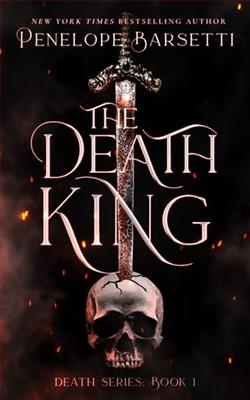
The Death King by Penelope Barsetti is a stunning entry into the dark fantasy genre that melds intricate world-building with deep, human elements that speak universally to the battles between light and darkness within us all. Barsetti crafts a tale that is not only thrilling but also deeply philosophical, delivering a narrative that captures both the imagination and the soul.
The novel introduces us to the mythical land of Eldoria, a realm fringed by the whispering darkness of Helldale and illuminated by the celestial might of the Crystal Mountains. In this vividly realized setting, we meet the protagonist, Caelan, a young warrior with a tormented past and an uncertain future. Caelan's life is turned upside down when he encounters the enigmatic and feared Death King, a sovereign whose name is whispered in dread by the inhabitants of Eldoria. Despite initial appearances, the Death King is not merely a harbinger of despair; rather, he is a complex character burdened with the immense responsibility of maintaining balance between life and death.
The strength of Barsetti's narrative lies in her ability to paint each scene with a finesse that borders on the poetic. Her descriptions of Eldoria are lush and vibrant, filled with a level of detail that makes the world leap off the page. The scenes set in the Silent Forest, where ancient trees are said to hold the secrets of the universe, are particularly evocative, drawing the reader into a sense of wonder and mystery.
The characters in The Death King are meticulously developed, with backstories and motivations that are both compelling and relatable. Caelan, as the central figure, undergoes a profound transformation throughout the book, grappling with his inner demons and his burgeoning understanding of his place in the world. His relationship with the Death King evolves from one of fear and hostility to a complex bond that challenges his beliefs about right and wrong, life and death.
One of the most striking aspects of the book is its exploration of themes such as redemption, fate, and the nature of evil. Barsetti isn't afraid to dive deep into these philosophical waters, and she handles such discussions with a maturity that enriches the narrative rather than bogging it down. The dialogue between Caelan and the Death King often serves as a medium for these explorations, providing insights into their characters while also pushing the plot forward.
The pacing of The Death King is another element worthy of praise. Barsetti manages to maintain a perfect balance between fast-paced action sequences and slower, more introspective moments. The battle scenes are choreographed with a clarity and intensity that make them exhilarating to read, while the quieter moments allow for character development and thematic depth.
However, no book is without its flaws. At times, the plot of The Death King can feel a bit convoluted, with so many twists and turns that it might be difficult for some readers to keep track of the unfolding events. Additionally, while Barsetti's prose is generally a delight, there are instances where the poetic quality can slip into overindulgence, resulting in descriptions that, though beautiful, may stall the narrative momentarily.
Despite these minor criticisms, The Death King remains an impressive work. It is rare to find a fantasy novel that so effectively intertwines action, character growth, and thematic depth. The novel concludes with a satisfying resolution that ties up the numerous plot threads while still leaving room for the reader's imagination to wander in the world of Eldoria.
In conclusion, The Death King by Penelope Barsetti is a must-read for fans of dark fantasy. With its rich narrative, complex characters, and philosophical underpinnings, it not only entertains but also invites readers to ponder the profound questions of their own existence. It’s a bold, imaginative, and thought-provoking novel that marks Barsetti as a significant voice in contemporary fantasy.



