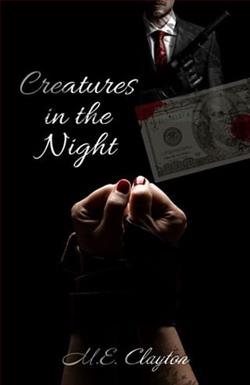
In "Creatures in the Night," M.E. Clayton takes readers on a dark and intriguing journey into the supernatural world, blending elements of horror, fantasy, and suspense. The novel, which is Clayton's third, showcases a matured style and an adeptness at creating an atmosphere that is as bewitching as it is unnerving. The story orbits around the enigmatic town of Eldritch Grove, a place where the line between the ordinary and the paranormal blurs, and where nightfall brings promises of terror and wonder.
The narrative takes a multidimensional approach by weaving multiple point-of-view characters, each with distinct voices and personal horrors. At the front and center is young Alice Winters, whose initial external conflict of moving to a new, mysterious town soon escalates into a confrontation with the literal monsters that whisper from the shadows. Clayton's portrayal of Alice is particularly compelling. She evolves from a disbelieving newcomer to a fierce participant in the town's hidden wars, her development carefully crafted and believable.
Supporting Alice is a cast of richly drawn characters, each contributing to the town's lore and the novel’s quilt of horror. From the enigmatic Mr. Black, whose antiquated bookstore seems a portal to other realms, to the cryptic Mrs. Willow, who knows far more than she shares, these secondary characters are neither purely good nor evil but are shaded with gray tones that enhance the book’s complex moral fabric. It is through these interactions that Clayton successfully muddles the reader's sense of truth, building suspense and a compelling urge to unravel the mysteries of Eldritch Grove.
Clayton’s narrative style in "Creatures in the Night" is notable for its rich descriptiveness and clever pacing. The mood of the novel is set with intense sensory descriptions that paint the chilling scenes vividly and help to build a continuous sense of dread. The creeping fog, the eerie glow of the moon, and the spine-tingling chill of the supernatural are almost palpable. Furthermore, the author smartly uses pacing as a tool to control the tension, with slow, brooding sections magnifying the fear factor just as effectively as the frenetic sequences of terror.
The thematic depth of the book adds an extra layer of interest. At its heart, the novel explores themes of identity and otherness, fear, and power. This is distinctly manifested in how the characters relate to the idea of "creatures in the night." For some, these creatures are the embodiment of their deepest fears; for others, they are just different beings to be understood and coexisted with. Clayton seems to challenge the reader’s perception of what is considered normal or monstrous, pushing for a reflection on acceptance and the irrational bases of fear.
However, no book is without its weaknesses. At times, the multiple narratives might seem fragmented, potentially confusing readers who might struggle to see the immediate connection between the disparate elements of the story. Moreover, in her eagerness to expand the novel’s universe, Clayton occasionally lapses into over-exposition, which can marginally detach the reader from the emotional gravity of the scene.
On a technical level, the writing is clean and direct, with just enough flourish to engage without overwhelming the narrative drive. There is a musicality in Clayton's prose that is particularly effective in horror writing, as it enhances the overall eeriness of the setting and plot developments. Dialogues are crafted with authenticity, which grounds the supernatural elements in a relatable reality, strengthening the reader's investment in the characters’ fates.
"Creatures in the Night" also deserves commendation for its visual imagination. The creatures that inhabit its pages are uniquely horrifying, drawn from folklore yet distinctly Clayton's own creations. These beings are not merely monsters but symbols of the primal fears lurking in human hearts, effectively serving both as antagonists and as devices to propel thematic revelations.
Overall, M.E. Clayton's "Creatures in the Night" is an absorbing blend of horror and fantasy that will likely appeal to fans of both genres. The atmospheric setting, complex characters, and philosophical underpinnings provide a rich tapestry that captivates and stimulates the mind. While the narrative structure might test some, the patient reader will be rewarded with a thoughtful examination of the unknown and the monstrous, both in the external world and within us. It’s an enthralling addition to the genre that reaffirms Clayton’s prowess in crafting deeply atmospheric and thought-provoking tales.



